
Overview
AI, GAI, ML, LLM, GANs, and GPTs are six interconnected technologies that together define today’s AI landscape. AI is the broader universe; ML is how that universe learns; generative AI is the subset that creates; large language models are how generative AI works with language; GANs are how it works with images and video, and GPTs are one specific architecture that powers most of the AI assistants enterprises are deploying today. Understanding how they relate is essential for any business deploying AI in 2026.
Introduction
The buzzwords such as Artificial Intelligence (AI), Generative AI (GAI), Machine Learning (ML), Large Language Models (LLMs), Generative Adversarial Networks (GANs), and Generative Pre-trained Transformers (GPTs) are everywhere, yet their meanings often blur together, leaving business leaders and professionals confused about what each technology does. This guide defines each term, explains how they relate to each other, and shows where each technology is applied in practice

What is Artificial Intelligence (AI)
AI, or artificial intelligence, refers to computer systems designed to perform tasks that typically require human intelligence, such as recognizing patterns, making decisions, understanding language, and solving problems.
In today’s Agentic AI times, deploying AI is not a choice but a necessity. It enables organizations to process large amounts of data faster than humans ever could, uncover hidden insights, automate repetitive tasks, reduce manual efforts, and make more accurate predictions. From credit risk modelling in banking to personalized customer experiences in retail, AI is transforming how companies operate and compete.
What is Machine Learning
Understanding the difference between AI and machine learning is not difficult. Machine Learning (ML) is a branch of AI that enables systems to learn from data and improve their performance over time without being programmed for every use case.
The role of classical ML algorithms in the Generative AI world remains important because instead of following rigid, pre-written rules, these algorithms identify patterns in data and use those patterns to make future predictions or decisions. So, think of ML as the engine that powers most of the modern AI applications. The more data an ML system processes, the better it becomes at its task, whether that is recommending products, detecting anomalies, or predicting sales.
Machine Learning Types & their Suitability
There are 3 types of machine learning, each suited for different types of problems:
- Supervised Learning- This ML approach works with labelled data, where the algorithm learns from examples that include both inputs and correct outputs.
- Example: To build a spam filter, you’d train the algorithm on thousands of emails already marked as “spam” or “not spam”. The system learns to recognize patterns that distinguish spam from legitimate messages.
- Common Applications: Credit scoring, sales forecasting, medical diagnoses, etc.
- Unsupervised Learning- This ML approach deals with unlabelled data, where the algorithm must discover hidden patterns, relationships or groupings on its own without human guidance.
- Example: Online platforms like Amazon or Netflix use this approach to analyze a user’s past behaviour and suggest relevant products, music, or movies that align with their interests.
- Common Applications: Anomaly detection, market basket analysis, customer segmentation, etc.
- Reinforcement Learning- This is one of the machine learning types that trains algorithms through trial and error, rewarding desired behaviours and taking action against negative (penalties) feedback.
- Example: Online platforms like Amazon or Netflix use this approach to analyze a user’s past behaviour and suggest relevant products, music, or movies that align with their interests.
- Common Applications: Dynamic pricing, resource allocation, portfolio optimization, developing smarter chatbots and text summarization, etc.
Generative AI Explained
Generative AI (GAI) is a subset of artificial intelligence that creates new content such as text, images, music, code, or video based on patterns from the existing data. Unlike traditional AI, which primarily analyzes data and makes predictions or classifications, Generative AI actually produces original outputs.
For example, traditional AI might categorize customer emails by sentiment, while GAI could draft personalized email responses. This creative capability is what makes GAI stand apart and explains why tools like DALL-E and ChatGPT have become so popular.

Large Language Models (LLMs)
Large Language Models (LLMs) are modern AI systems trained on massive amounts of text data to understand and generate human-like language. They can comprehend context, answer questions, write content, and even reason through difficult problems. Large Language Models have transformed how businesses handle text-based tasks.
What can LLMs do:
- Voice bots & chatbots that offer contextual, natural responses to customers instead of scripted replies.
- Document summarization that condenses long reports, contracts, or research papers into brief summaries.
- Automated content analysis from legal documents, market research, and customer reviews.
In the evolving age of agentic AI for GCCs and large enterprises, many conversational AI tools are supported with these AI models, because of which businesses now rely on them for efficiency and scale.
What is GANs in AI
Generative Adversarial Networks (GANs) are a specific class of ML model consisting of two neural networks that compete against each other. Talking about how GANs work, there are two components, a generator and a discriminator. One generates synthetic data, while the other evaluates whether it’s real or fake.
The results of this competitive process are remarkably realistic. GANs are especially helpful for producing synthetic data that maintains the statistical characteristics of real data while protecting:
- privacy
- producing high-quality images for marketing and design
- improving low-resolution images
- simulating scenarios for testing and training other AI systems
GPTs: Generative Pre-trained Transformers
Generative pre-trained transformers (GPTs) are a specific type of large language model that uses a transformer architecture and pre-training on large datasets to understand and generate human language with exceptional quality.
GPTs represent one of the most successful approaches to building LLMs. This is how LLMs are transforming customer experience and business operations in BFSI, CPG, auto OEM, aviation, hospitality, etc.:
- Content generation: Creating marketing copy, reports, articles, and social media posts with less manual effort.
- Conversational AI: Powering chatbots that handle complex customer feedback and enquiries across various industries.
- Coding assistance: Helping developers write, debug, and explain code, significantly accelerating software development.
The pre-trained aspect in GPTs means that these models arrive with broad knowledge that can be fine-tuned for specific business needs, making them both powerful and adaptable.
Key Differences Between AI, GAI, ML, LLM, GANs, and GPTs
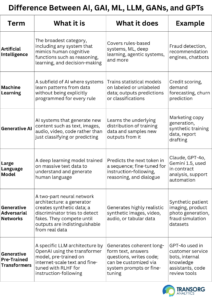
The table lists the clear distinctions between AI vs ML, LLM vs GPT, and GAI vs GANs.
Applications of AI across Industries
The sectors where you will see AI applications are:
- Healthcare- AI assists in diagnosing diseases from medical imaging, predicting patient outcomes, accelerating drug discovery and conducting clinical trials.
- Education- AI enables adaptive learning platforms that customize educational content based on individual performance and learning styles.
- Transportation- Self-driving vehicles, traffic management, route optimization, and predictive maintenance systems rely on AI to improve safety and efficiency.
- Entertainment- Streaming platforms use AI to recommend content and targeted advertising, while studios use it for visual effects and content creation.
- Retail- The use of AI in retail is AI helps in stockpiling, demand forecasting, trade promotion optimization, inventory management, product recommendations, etc.
- BFSI- AI in banking, financial services and insurance sector is used for fraud detection, credit risk assessment, automated customer support, etc.
- Manufacturing- AI in manufacturing industries is used in use cases such as quality control, predictive maintenance, and supply chain optimization.
- Aviation- Customer journey analytics and segmentation, roster analytics, etc., are some areas where AI is used in the aviation industry.
Final Words
Understanding the distinctions between AI, GAI, ML, LLM, GANs, and GPTs doesn’t require a technical degree but requires clarity about what each technology does and where it fits in the broader artificial intelligence landscape.
Whether it’s about AI in banking or any other industry, as these technologies continue to evolve and integrate into day-to-day business operations, knowing which tool solves which problem becomes a competitive advantage.
As the future of these machine learning technologies, agentic AI and AI-powered analytics evolve, TransOrg Analytics is helping industry leaders solve complex business problems, saving time and money through TransOrgIQ– an agentic AI platform that enables 90% faster decision-making through data-driven insights. If you are also looking to scale up your business operations, maximize revenue, and optimize costs, get in touch with us today to schedule a customized demo for your actual business problem.
FAQs
1- What is artificial intelligence (AI)?
Artificial Intelligence is the new way of making computers perform tasks that require human intelligence, such as problem-solving, writing, decision-making, etc. AI ensures that the systems work like humans by using algorithms and large amounts of data to recognize patterns. The examples of successful AI implementation includes Siri, Alexa, self-driving cars, medical diagnostics, etc.
2- What is generative AI?
GAI, or generative AI, is a type of artificial intelligence that not just analyzes existing information but also learns from the vast data sets to create new, original content like images, videos, music or text. Different types of generative AI models use neural networks to learn underlying patterns, structures and styles.
3- What are the main types of machine learning?
There are 3 main machine learning types: Supervised learning (from labelled data), Unsupervised learning (from unlabelled data), and Reinforcement learning (learning through trial and error with rewards). The other important types include: Semi-supervised learning and Self-supervised learning.
4- What is an LLM in AI?
Large Language Models in AI are powerful deep learning models trained on vast datasets to understand, generate, and process human language for performing tasks like translating, summarizing, creating content, and answering questions. Examples include GPT-4, Claude, Gemini, and Llama.
5- What is GANs in AI?
GANs (Generative Adversarial Networks) in AI are deep learning models with 2 neural networks that train each other to create new and realistic data like images or text. The key use cases and examples include creating photorealistic faces of people who don’t exist, generating unique art and music, enhancing low-resolution images, etc.
6- Are GPTs and LLMs the same?
No, GPTs and LLMs are not the same. While LLMs are a broad category of models for language tasks, GPT is a specific series of LLMs developed by OpenAI. The versions for LLMs vary by organization and research, whereas, for GPT, the versions include GPT-1, GPT-2, GPT-3, GPT-4, etc.