Overview
A data governance framework is the operating system for trustworthy data that defines the rules, ownership structures, and automated controls that decide whether data is reliable enough to power AI, survive a regulatory audit, and support a board decision. In BFSI specifically, this means mapping every control to DPDP and RBI obligations simultaneously, certifying datasets before they feed AI models, and replacing manual policy documents with governance that is enforced inside the data pipeline itself.
Key Insights
Most data governance framework conversations in BFSI are still treated as prep for a 2027 compliance deadline. That timeline just moved closer. The Data Protection Board of India is now staffed, Consent Managers go live in November 2026, and “soft enforcement” is already underway, yet according to EY India’s “India’s digital privacy crossroads” survey, nearly 83% of organizations have not begun comprehensive DPDP implementation.
What is AI-Ready Data Governance in BFSI
AI-ready data governance is the state where every dataset feeding a BFSI production model has been checked for accuracy, completeness, consistency, complete end-to-end data lineage tracking, a documented bias assessment, and access controls that are enforced at the system level.
AI-ready data governance in BFSI matters because leaders are under constant pressure to show AI value, and the data behind that pressure is now well-documented. According to IBM’s 2025 Cost of a Data Breach Report, 97% of AI-related breaches occurred at organizations lacking proper AI access controls, and 63% of organizations had no formal AI-ready governance policy in place at all. An agentic AI platform that executes decisions, like flagging a transaction or adjusting a credit limit, inherits whatever governance gaps sit underneath it.
What is Data Compliance?
Data compliance is the foundation that ensures that your data handling aligns with the standards set by external laws and regulations, such as HIPAA, GDPR, RBI, CCPA, or industry-specific mandates. It is how your data governance framework and practices hold up under regulatory and legal scrutiny.
How Data Governance Framework Decisions Actually Flow
Governance decisions in an organization tend to move in one of the few patterns mentioned below:
- Top-down: the board or CDO sets a standard, and it flows down to every business unit.
- Bottom-up: practices that work well in one team get adopted more broadly upward.
- Center-out: one central team sets the standard and the rest of the teams follow it.
- Hybrid: This is the data governance framework approach most BFSI institutions actually run on. The board and CDO set the standard top-down, while the CRO and CISO drive bottom-up enforcement within their own risk and security functions.
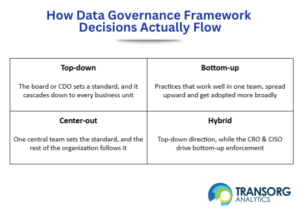
Naming which model you’re actually running, rather than assuming everyone already agrees, is a useful exercise on its own. Most data governance frameworks fail not because the rules are wrong, but because nobody agreed in advance on who has the final say.
What TransOrg’s 4-Pillar BFSI Data Governance Framework Actually Decides
It is easier to evaluate an enterprise data governance framework when you break it into four simple categories, rather than treating it as one long list of requirements:
- Policies (The rules): Specific and measurable rules such as what counts as acceptable data quality, how sensitive customer data is classified differently from internal reporting data; who can view, edit, or delete each type of data; how long data is retained before it’s deleted; and whether that matches what DPDP Act compliance for banks and RBI data governance compliance require.
- Processes (The enforcement mechanism): Repeatable steps that make the policies real, such as how data is validated as it enters a system, what happens when a data mapping or quality issue is flagged, who is notified, how fast the resolution is, and how policies get updated when a new regulation lands.
- Technology (The automation layer): Systems that enforce the rules automatically, because policies alone don’t stop a problem at 2am. This part of the data governance framework includes data catalogs, lineage tracking tools, and access management systems with real audit logs.
- Metrics (The proof): The quantified proof that policies, processes, and technology are working, including audit findings trending down, time-to-trace-a-number, and share of AI models on certified data. Without this, data governance framework is paperwork rather than protection
Where Data Governance Framework Breaks Down in Practice
BCBS 239 is not just one regulation but one piece of a larger supervisory system. Basel III, ICAAP, ILAAP, and ongoing stress-testing requirements all sit alongside it, and together they’re designed to make financial institutions more resilient, not just individually compliant.
BCBS 239 requires end-to-end data lineage and traceability at the attribute level, but most Indian banks cannot produce this on demand today. TransOrg’s agentic data management solution provides end-to-end visibility and monitoring of data flows to ensure that reporting paths are well-mapped and validated.
The common reasons for data lineage failure are:
- Lineage documentation exists at the system level (which application touched which database) but not at the attribute level (which specific field was transformed how and by which process).
- Regulators are now asking the attribute-level question, and that mismatch is exactly what shows up as a finding during a regulatory or BCBS 239 readiness review.
Passive lineage only documents the problem after it has already happened. Active lineage is the only way to catch it in time. It is where the system itself sends an alert the moment something upstream changes and affects a risk report or regulatory submission. This is the number that a CRO needs to be able to answer before a regulator asks.
Why are Data Governance Frameworks and Compliance Important for BFSI?
Banking, financial services and insurance domains run on the most regulated, targeted, and relied-upon data. A well-established data governance framework is what makes the data defensible on all three fronts: it satisfies regulators, reduces the fraudulent attacks, and gives the board confidence in the numbers on which decisions are made.
Here’s why data governance frameworks are important for banking, insurance, and financial services:
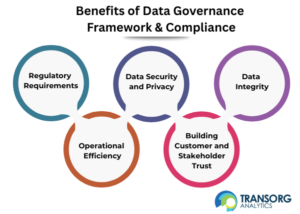
Metrics that Matter to Fund BFSI Data Governance Framework in 2026
Boards in banking, financial services, and insurance fund evidence that risk and cost are going down or regulatory standing is improving. If governance activity, policies and council meetings say nothing about whether the institution is safer than it was last quarter, it won’t get funded.
Here’s what a data governance framework’s metrics look like:
- For the CRO, the question is audit exposure. Not “how many policies exist” but “how many fewer findings did the last audit cycle produce, and how much faster can we trace a number back to its source?” Audit findings and the time it takes to produce a regulatory report on demand are the two numbers that matter here.
- For the CISO, the question is whether access is actually enforced, not just written down. A policy document isn’t a control. The number that matters is how much of the institution’s sensitive data sits behind access controls that are enforced at the system level.
- For the CDO, the question is AI credibility. Not “how much data have we governed?” but “how much of our production AI can we actually defend to a regulator?” The share of AI models running on certified data is the number that answers that, and it’s the same question that sits at the center of model risk management for any institution running credit or underwriting models.
- For the CFO, the question is exposure avoided. Not “What did governance cost?” but “What penalty, breach, or remediation did it prevent, and how does that compare to the spend?” This is the number that turns governance from a cost center into a line item the CFO can defend.
- For the full board, the question is readiness. If DPDP enforcement or an RBI audit landed tomorrow, how fast could the institution respond, and with what confidence? Breach and breach-notification readiness against the regulator’s actual time window is the single number that answers this most directly.
A number is only a metric if someone in the room can act on it. For example, “We cataloged 4,200 datasets” doesn’t change anyone’s next decision, but “We cut audit findings from 23 to 4” does.
What Automated Data Governance Framework in 2026 Unlocks at Scale
Automated data governance is the process where governance controls required as per the DPDP Act compliance for banks and RBI data governance compliance are embedded directly into data pipelines, catalogs, and AI workflows, ensuring quality checks, end-to-end data lineage, data observability and access enforcement that operate without continuous manual intervention.
- Automated dataset classification and tagging
- Early anomaly detection to detect data quality issues
- Reduced governance overhead on engineering teams
- Eliminates the manual audit preparation
- Continuous metadata monitoring across systems
- End-to-end lineage tracking to map data movement and dependencies
Conclusion
Data governance and compliance now sit at the core of the BFSI domain. It is the infrastructure that decides whether your AI can be trusted. Market expansion, execution prioritization, and regulatory pressures all demand sustained investment in structured governance frameworks. Organizations that integrate technology, have clear accountability, and ensure data quality management are better positioned to manage risk and unlock consistent value from their data sets.
The DPDP’s Consent Manager deadline is months away, and the question is not about whether to invest in governance but how much the gap is already costing every quarter until it is resolved. To see how TransOrg Analytics helps BFSI institutions build AI-ready, audit-defensible data governance for financial services, explore our agentic AI platform, TransOrgIQ, or get in touch with our team.
FAQs
1- What is a data governance framework?
It is the operating model that defines who owns data, how its quality is measured, how its lineage is tracked, and how access and consent are enforced, so that the data can be trusted by regulators, auditors, and AI systems alike.
2- Why do AI projects stall without strong data governance?
AI projects stall because ungoverned data produces outputs that fail audit and oversight scrutiny. Reports found that 97% of AI-related breaches occurred where access controls were missing, and that most organizations still lack a formal AI governance policy. A model is only as defensible as the governance behind the data that trained it.
3- Are data governance and data compliance the same?
No, data governance and compliance are not the same. Governance is the foundation of how you manage your data and access controls, whereas compliance ensures you are doing it within the standard set by regulatory bodies. Together, they ensure that your enterprise data is well-managed, trusted, and secure.
4- How does a BFSI data governance framework satisfy RBI and DPDP at the same time?
The BFSI data governance framework satisfies RBI and DPDP by mapping each control, such as consent management, access enforcement, lineage, and breach reporting, to the specific clause it satisfies across regimes, rather than running separate programs for each regulator. The underlying infrastructure, classification, ownership, lineage, and quality monitoring are the same regardless of which regulator is asking.
5- What does “AI-ready” data actually mean for a CDO?
AI-ready data means every production dataset has a certified quality score, complete lineage, a documented bias assessment, and enforced access controls, with a named owner accountable for each. A CDO who cannot produce this on demand has a governance gap, not simply an AI gap.
6- What is AI-ready data governance?
AI-ready data governance means every dataset used in a production AI model has a certified quality score, complete lineage, a documented bias assessment, and enforced access controls, with a named person accountable for each. Most organizations claim this without actually having it in place.
7- Who should be on a bank’s data council?
Representatives from each major data domain, typically the CDO, CRO, CFO, and CISO functions, plus a Model Owner once AI is in production, must be on a bank’s data council. The council’s job is to resolve disagreements between domains before they turn into audit findings.
8- What is the cost of poor data quality for a bank?
Gartner estimates $12.9M annually in direct costs on average. For Indian banks, DPDP non-compliance adds penalty exposure of up to ₹250 crore per violation category. AI models trained on poor-quality data produce outputs that fail regulatory scrutiny; remediation costs 3–5x more than building on governed data from the start.