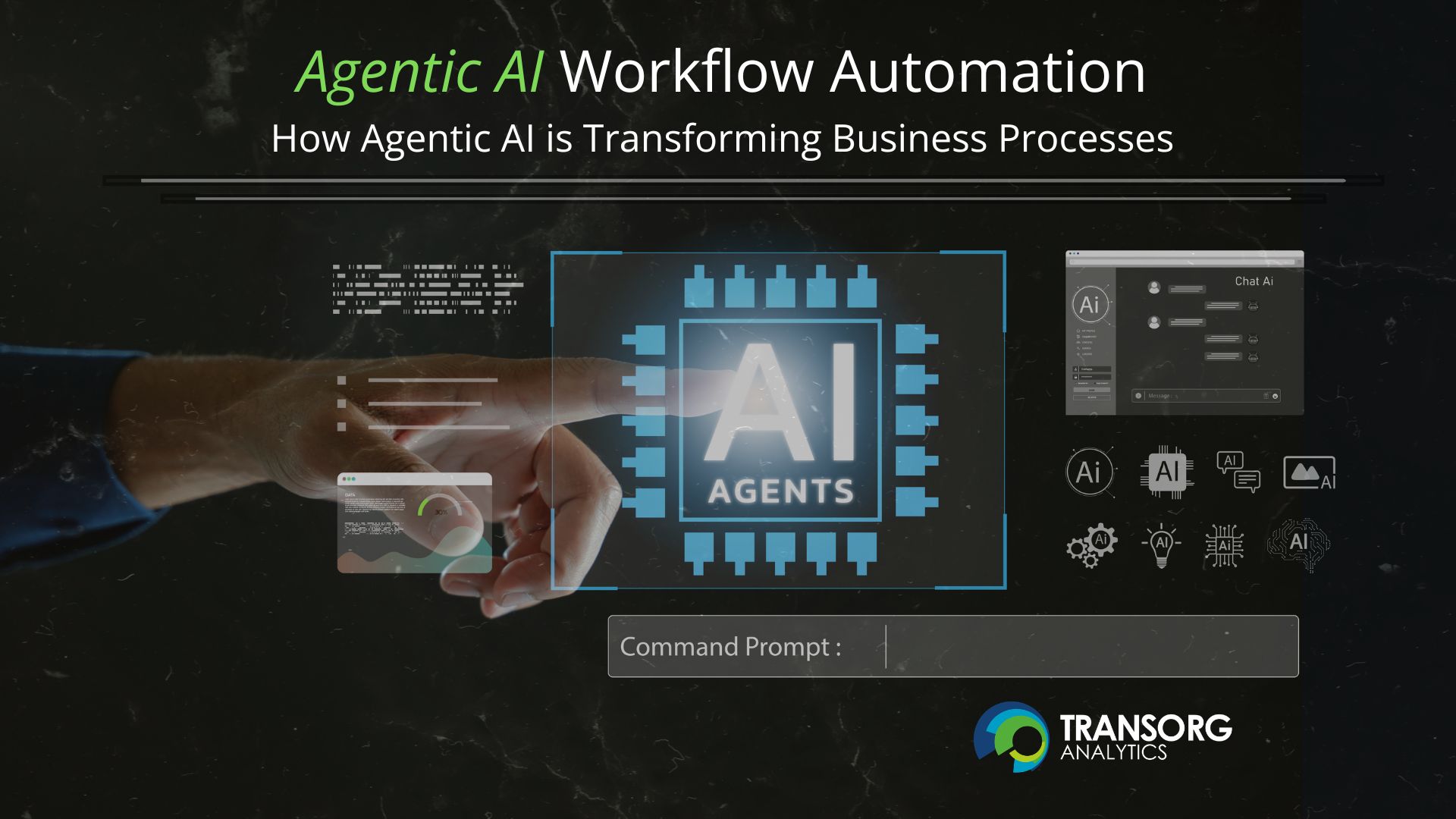
AI workflow automation is the use of artificial intelligence to manage, execute, and optimize multi-step business processes, including tasks that involve unstructured data, exceptions, and real-time decisions. Unlike rule-based automation which follows a fixed set of instructions, AI workflow automation can make decisions, learn from outcomes, and adapt without being manually reprogrammed. It replaces manual, repetitive processes with AI systems that understand context and handle complexity.
Introduction
Every day, AI workflow automation is quietly reshaping how enterprises operate and scale. Businesses that still rely on manual processes face similar challenges, such as revenue cycles slow to a crawl, errors increase as data is passed through spreadsheets, and growth slows down because every step requires a human to move it forward.
Traditional AI automation tools like robotic process automation (RPA) and rule-based workflow engines helped reduce some of this friction, but they hit a ceiling. The moment an exception arises, such as a customer interaction falls outside a predefined scenario, the automation breaks and a human has to intervene.
Agentic business process automation removes that ceiling by adding reasoning, adaptability and continuous learning features to the automation layers, enabling systems to handle unstructured and difficult tasks. AI agents execute multi-step tasks independently, without waiting for step-by-step human instruction.
This blog breaks down what AI workflow automation is, how agentic AI differs from the tools that came before it, and where it is already delivering results. By the end, you will have a clear picture of where this new approach fits in your organization and how to get started.
What is AI Workflow Automation?
AI workflow automation involves the use of AI agents to govern, monitor and optimize multi-step business processes involving unstructured data and outlier cases to facilitate real-time decisions.
What is Business Process Automation?
Business process automation refers to the use of technology to automate repetitive, rule-based tasks without human intervention. It is designed for structured and predictable workflows where the logic is completely encoded beforehand.
What is Intelligent Process Automation?
Intelligent process automation lies between traditional process automation and fully autonomous AI systems by leveraging robotic process automation with AI capabilities, including classical ML and natural language processing. Since rule-based tools cannot handle complex, exceptional workflows, intelligent process automation helps in dealing with them quickly and reliably.
What is the difference between traditional automation and AI-driven approaches?
The major difference between traditional automation and AI-driven approaches lies in how each of them handles friction or variation. The strength as well as limitation of traditional automation is that it runs on a preset script without any deviation, reliably and quickly. However, when inputs fall outside expected parameters, traditional automation fails. AI workflow automation does not just execute tasks, it understands context, handles exceptions and improves over time without manual reprogramming.
In today’s enterprise technology stack, agentic AI workflow automation does not replace humans completely. Instead , it removes the manual layer between systems and decisions such as data gathering, document handling, status updating, and cross-system co-ordination that consumes time. People are freed to focus on tasks that genuinely require human reasoning, while the system handles everything that does not.
What is Agentic AI?
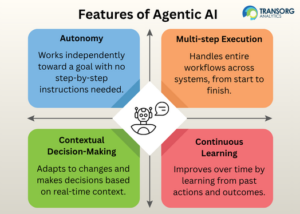
Agentic AI refers to AI systems that operate autonomously to complete multi-step tasks, make decisions, and adapt their approach based on context with minimal human intervention.
Agentic AI vs Traditional Automation
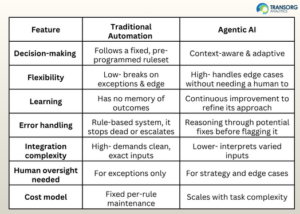
The difference between traditional automation and agentic AI is not just speed but is the ability to reason.
The table below describes the key dimensions of this difference, from how each approach handles decisions to how each scales with complexity.
High-Impact Agentic AI Use Cases
Agentic AI use cases are not theoretical anymore. Across various industries such as banking, financial services, insurance, CPG, retail, and hospitality, the high-impact agentic AI use cases share a common profile:
- Focused on revenue, cost, or risk impact
- Include high-volume workflows
- Involve multiple systems and data sources
- Operate within clear guardrails
Here are some industry-wide areas where the impact of agentic business process automation is clearly visible:
1- Customer Lifecycle Automation
This is one of the most important areas where agentic AI is showing results since it involves many touch points and systems, with higher chances of delay and error. This includes:
- Customer onboarding: AI agents collect and verify documents and take actions on further communications. This reduces response time from days to hours without manual efforts.
- Collections and recovery: With agentic AI, collections and recovery are managed based on the user’s payment behavior. Also, it helps you keep customers engaged with the right message at the right time. Humans are involved only when necessary and keep a clear record for regulatory checks.
- Underwriting and risk scoring: Agentic AI pulls data from multiple sources, applies scoring logic, flags anomalies, and routes decisions. This eliminates the manual data-gathering that slows underwriting cycles.
- Churn prediction: Autonomous AI agents in business identify at-risk customers using behavioral signals and initiate retention workflows autonomously, reaching customers before they disengage.
Impact- Customer lifecycle automation with agentic AI replaces fragmented and manual workflows with continuous and real-time adaptable AI workflow automation.
2- Agentic AI for Sales Automation
Agentic AI in business operations targets specific points in the sales cycle where it delivers measurable ROI:
- Real-time sales coaching: AI helps you analyze live calls and competitor data and also gives appropriate responses to the representatives in real-time.
- Lead qualification & follow-up: AI filters high-quality leads using CRM data and buying signals. It prioritizes the best leads and ensures timely follow-ups, improving conversion rates.
- Call analysis & scoring: AI automatically analyzes calls and shares quick insights with managers, saving hours of review time.
Impact: AI for sales automation does not replace sales teams; it removes the manual efforts of updating CRMs and doing follow-ups.
5 Benefits of Agentic AI Workflow Automation
The answer to why use AI workflow automation in business processes are:
- Faster revenue cycles: With reduction in manual efforts between sales, onboarding and finance, business processes such as contract processing, payment approvals and customer onboarding now take hours instead of weeks. For large and global enterprises, this has a direct impact on cash flow and customer experience.
- Reduced manual efforts: Agentic AI removes humans from low-value steps of the processes, such as data entry, document chasing, and status reporting, by enabling agentic data management and governance. This helps humans to put effort towards judgement-intensive work that AI cannot replicate.
- Improved decision-making: In every enterprise, data errors are common. With AI automation tools these errors are reduced or eliminated. This helps the human decision-maker to work and make decisions with better inputs.
- Better Scalability: In fast-growing enterprises, as the demand scales, the hiring cycle becomes inefficient. Agentic AI workflow automation scales with demand automatically.
- Consistent data management and governance: In regulated industries, with agentic AI for data management and governance, audit risks and remediation costs are reduced in case of errors.
Challenges and Risks of Agentic AI in Business
Agentic AI is not without risk. Acknowledging these challenges is not a reason to avoid technology. Instead, it can help you save on additional costs that arise when there’s any mistake or breach in rules.
The major risks associated with agentic AI workflow automation are:
- Over-automation: When processes that require conversation or understanding are automated, it can feel impersonal and can damage relationships and trust.
- Integration gaps: Agentic AI platforms for decision-making require access to multiple systems. Errors can happen when APIs are poorly documented, old infrastructure is used or data is being recorded in different systems, leading to incomplete information.
- Accountability and Responsibility: When an autonomous agent makes a decision, such as approving a loan, rejecting an application, or initiating a transaction, knowing responsibility becomes difficult. This can lead to financial or ethical damage.
- Ethical and Regulatory Challenges: When Agentic AI makes value-based or sensitive decisions, it can violate fairness and privacy norms. Such risks can lead to reputational harm and loss of trust.
- Bias and Fairness: Since agentic AI systems can use historical or past data, there can be historical or societal bias. This can lead to unfair outcomes and thus poor decisions.
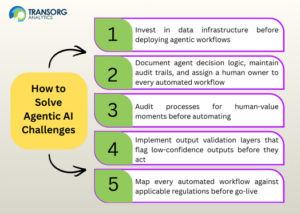
Ways to Solve Agentic AI Challenges in Business Operations
These risks are real but manageable. The enterprises that are successfully deploying agentic AI took care of governance first.
How to implement Agentic AI in Business Operations
Today, agentic AI workflow automation is transforming business processes in global organizations. But the question that most of the leaders are asking is, how can they implement agentic AI effectively in their business? The answer to this is:
- Assess your business needs and opportunities: Identify the processes where human involvement is repetitive, costly or inefficient. Once it’s done, define clear goals or results that you want to achieve.
- Choose low-risk use cases: Business processes such as document processing or back-office work are repetitive and volume-heavy. These processes carry less risk and give faster results to test the efficiency of agentic AI to start.
- Select the right AI automation tools: Go for tools based on their integration capability with your existing stack and explainability of AI decisions. The right tool depends on your infrastructure.
- Involve humans for high-value decisions: Agentic AI is not here to replace humans. There are decisions that require human approval; otherwise, it might put companies at risk of financial loss, so remember to involve a human in the decision-making process.
- Run a pilot project: Take a single business process and have clear and measurable objectives that you would like to attain from it – e.g., time savings, reduced error, etc. Roll out agentic AI for 6-8 weeks and let it make appropriate decisions.
- Scale with governance: Compliance and regulations are non-negotiable. Keep AI trust and security as your top priorities to avoid any future costs or reputation damages.
Implementing agentic AI workflow automation is more about choosing the right process instead of choosing the right tool for maximum ROI.
Key Takeaways
The above blog covers all the important aspects of agentic business process automation. The key takeaways are:
- Agentic AI workflow automation replaces manual and rule-based processes and drives faster decision-making for enterprises.
- Agentic systems continuously learn and improve with time to handle exceptions and unstructured data to deliver the best results suitable for your business.
- Agentic AI can be applied to various business use cases, such as customer lifecycle management, campaign analytics, hiring and retiring cycles, root cause analysis, software development lifecycle, etc.
- The right AI automation tools, combined with built-in guardrails and governance frameworks, allow enterprises to scale flexibly and quickly.
Conclusion
Today, enterprises are moving from experimentation to implementation of agentic AI due to its operational and financial advantages. AI workflow automation reduces manual efforts and brings an intelligence layer to handle difficult tasks based on unstructured inputs.
The business processes are now faster, efficient and resilient. Lastly, the question is not about whether to automate or not but which workflows to automate first.
So, if you are wanting to implement agentic AI in your business processes but not sure of your high-impact use cases, connect with us today!
FAQs
1. What is AI workflow automation?
AI workflow automation is the use of artificial intelligence to manage, execute, and optimise volume-heavy business processes which involve unstructured data, exceptions, and real-time decisions. It learns from outcomes and improves with time for better results.
2. How is agentic AI different from traditional automation?
Agentic AI differs from traditional automation in that it can plan, make decisions, and handle exceptions independently rather than following a fixed set of rules. Traditional business process automation breaks when inputs deviate from expected formats; agentic AI reasons through the gap and continues.
3. What are the best agentic AI use cases in business?
The best agentic AI use cases in business include customer lifecycle automation, sales automation, document processing, root cause analysis, software development lifecycle, etc. These are high-volume processes that consume most of human energy in enterprises and are high-impact ones for agentic AI deployment results.
4. What is intelligent process automation?
Intelligent process automation combines robotic process automation with AI capabilities such as ML and natural language processing to handle difficult and exception-heavy workflows. It adds a reasoning layer to automation without requiring full autonomy.
5. What are autonomous AI agents in business?
Autonomous AI agents in business are capable of planning, executing, and adjusting tasks across multiple tools and systems without step-by-step human efforts. They receive a goal and determine how to achieve it independently.
6. How does AI improve sales processes?
AI for sales automation improves sales processes by automating lead qualification, real-time call coaching, follow-up sequencing, and pipeline forecasting. Sales representatives spend more time on high-value conversations and less time on administrative tasks that do not directly drive revenue.
7. Can AI automate customer onboarding?
Yes, customer lifecycle automation enables AI agents to handle document collection, identity verification, system provisioning, and onboarding communications end-to-end. AI automation in this process has reduced the cycle time from weeks to hours with minimal human inputs.
8. What are the risks of agentic AI in business operations?
The major risks of using agentic AI in business include bias and hallucination issues, compliance breaches, over-automation of human-value processes, and audit trails.
9. How is AI used in business operations?
AI in business operations automates heavy-volume workflows such as document processing, customer analytics, resource allocation and reporting, removing the manual layer between data and action.
10. What are the best AI automation tools for business?
The best AI automation tools for business depend on the following: integration capability with existing systems, explainability of AI decisions, and the ability to keep human-in-the-loop checkpoints for high-value tasks.