Introduction
Generative AI and agentic AI dominate every conversation about the future of technology. Classical machine learning, meanwhile, runs most of the decisions that actually affect businesses today. The decisions such as,
- The credit score that determines whether someone gets a loan
- The fraud detection that blocks a suspicious transaction in seconds
- The demand forecast that keeps a hospital’s supply chain functional
None of these run on ChatGPT; they run on techniques like gradient boosting, logistic regression and random forests. This creates a genuine risk because classical AI gets dismissed as legacy technology by teams chasing the latest models.
However, classical ML is not the past of AI; it is the present of most production AI systems running in banks, hospitals, retail and manufacturing businesses today.
This guide will help you understand when to use it, why it outperforms deep learning on structured data, and how it works alongside generative and agentic AI best as partners rather than competitors.
What Is Classical Machine Learning?
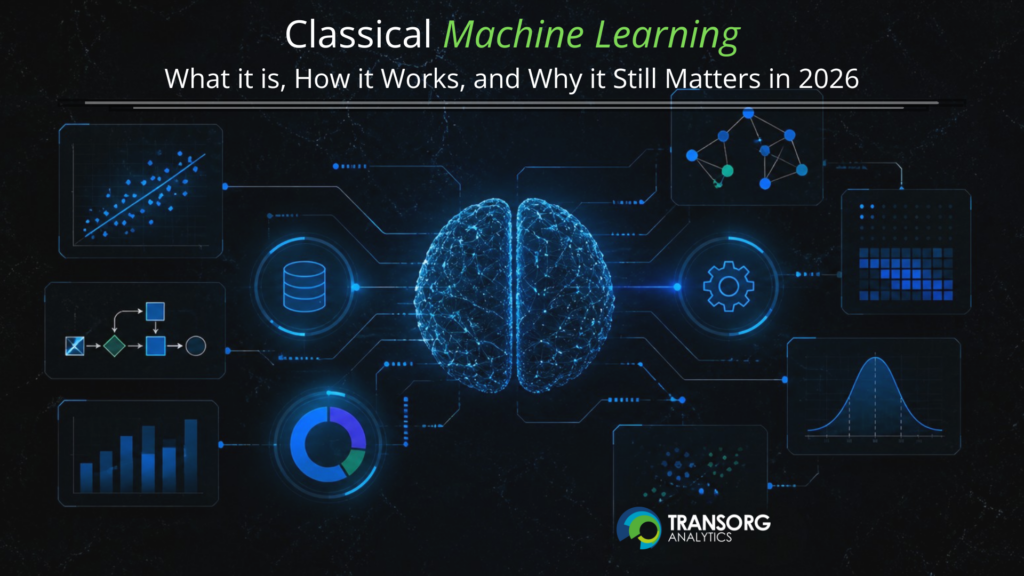
Classical machine learning is a way of analyzing and predicting outcomes based on existing data.
It encompasses supervised, unsupervised, and reinforcement learning built on mathematical statistics rather than deep neural network approximation.
What does Classical Machine Learning Do?
Classical ML learns from the historical or predetermined datasets and performs well with a defined scope and characteristics.
What does Classical Machine Learning Not Do?
Classical ML does not generate text, images, audio, or any specific content. This is what generative AI does.
- Classical machine learning sits between rule-based systems, explicit-if-then-logic code and deep learning or generative AI.
- It occupies the middle ground; it learns from data. It does so with algorithms that remain interpretable, auditable and tractable on standard hardware.
What is Classical Artificial Intelligence?
The different types of classical ML algorithms that teams still use are:
1- Supervised learning – These algorithms are trained on labelled data, such as inputs paired with known outputs, and learn to predict the output of new inputs.
- Logistic and linear regression: These are used for binary or continuous predictions, respectively. Logistic regression gives a probability that an applicant is likely to default, churn or convert, whereas linear regression gives a continuous value like a price, a quantity or a score. These are used in credit risk modeling, pricing optimization, and churn prediction.
- Decision trees and random forests: In decision trees, a flowchart-like structure is built where features, rules and the final result are denoted through internal nodes, branches and leaves. The random forest algorithm combines multiple models, or decision trees, to solve a problem and for better accuracy. These are used in fraud detection, medical diagnosis, and customer segmentation.
- Support vector machines: It is one of the supervised classical ML algorithms used for regression and classification tasks. It is used when a user wants to do binary classification, like spam vs not spam, etc. It is used in text classification and bioinformatics.
- Gradient boosting methods: XGBoost, LightGBM and CatBoost are the top-performing classical ML algorithms that build sequential ensembles where each successive model corrects the errors of its predecessor. It is used in risk analytics, insurance underwriting, ML model audit and validation, retail forecasting, etc.
2- Unsupervised Learning – These algorithms are trained on unlabelled data, for example, flagging anomalies, reducing dimensions or identifying clusters without being told what to look for.
This includes techniques like:
-
- K-means clustering: It is used in customer segmentation and anomaly detection as a practical baseline method.
- Principal Component Analysis (PCA): It is used for feature reduction before modelling and for visualising high-dimensional data.
- Isolation Forest and One-Class Support Vector Machines: These are used in fraud detection, network intrusion detection, and industrial equipment monitoring.
3- Reinforcement Learning – This classical machine learning technique is when an agent is trained through interactions with its environment for better outcomes. It is used in recommendation engines, logistics optimization, and dynamic pricing systems.
Advantages of Classical Machine Learning vs Deep Learning
The major advantages of classical ML vs deep learning are:
- Classical machine learning is easier to interpret than deep learning. Techniques like decision trees and logistic regression show exactly why each prediction was made.
- Classical ML performs better on structured and tabular data than deep learning.
- Classical ML is more data-efficient since it achieves better results with thousands of rows, whereas deep learning needs many examples to generalize reliably.
- Classical machine learning methods have lower computational costs since no large infrastructure or GPU clusters are needed.
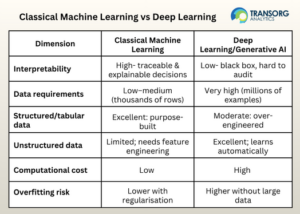
Business Areas Where Classical Machine Learning Still Performs Better
The following areas are where classical ML is correct and is often a legally required choice:
- Credit risk and fraud detection because of tabular data and interpretability
- Customer churn and lifetime value because of structured data volumes with higher accuracy over neural networks.
- Anomaly detection in operations because of no requirements for labelled examples in the case of equipment failures and financial anomalies.
- Demand forecasting and supply chains because classical ML handles and interprets structured, time-indexed supply chain data better than deep sequence models.
- Regulatory compliance and audit because of explainability for each action, thus better auditability.
How do Classical ML and Generative AI work together?
Classical machine learning and generative AI are not competitors; instead, they complement each other for better results and insights.
- Classical ML handles structured data, whereas generative AI handles unstructured content, covering the full AI stack.
- Classical ML reduces the noise and can provide crucial context, control and analytical accuracy for better generative responses.
- In complex AI business workflow automation scenarios, classic machine learning models might diagnose a situation, generative AI determines the appropriate synthesized response or action and agentic AI acts
Conclusion
Artificial intelligence is continuously growing and evolving. While both classical machine learning and generative AI carry unique strengths and limitations , the best enterprise AI platforms do not use them against each other; instead, combine them for a more practical integration.
Lastly, while these two are distinct stages, understanding their individual strengths and strategic importance allows enterprises to develop powerful, user-centric and more accurate AI systems. At TransOrg Analytics, we leverage the strengths of classical ML, generative AI and agentic AI for businesses to drive real-time insights, compliance and business value. If you are looking to get real-time advantages through your data and insights, connect with us today!
FAQs
1- What is classical machine learning?
Classical machine learning is a family of statistical algorithms that learn patterns from structured or labelled data to make predictions, classifications, or detections without generating new content. Classical ML includes supervised learning (regression, decision trees, SVM, gradient boosting), unsupervised learning (clustering, PCA, anomaly detection), and reinforcement learning.
2- What is classical AI?
‘Classical AI’ (classical artificial intelligence) refers to pre-deep-learning AI systems that reason from structured inputs, including rule-based expert systems and classical machine learning algorithms. Classical AI systems are deterministic, interpretable, and explainable, making them the preferred approach in regulated industries where decision audit trails are required.
3- What are the advantages of classical machine learning compared to deep learning?
The key advantages of classical machine learning compared to deep learning are interpretability, data efficiency, lower computational cost, and superior structured data performance. Classical ML is not better than deep learning on unstructured data (images and text) and is not obsolete.
4- Is classical machine learning easier to interpret than deep learning?
Yes, interpretability is the primary advantage of classical machine learning over deep learning. Algorithms like logistic regression, decision trees, and gradient boosting provide traceable, auditable decision logic. This makes classical ML the preferred approach in banking, healthcare, and insurance, where regulators require explanations for model-driven decisions.
5- What are the classical machine learning algorithms?
The main classical ML algorithms are logistic regression, linear regression, decision trees, random forests, gradient boosting (XGBoost, LightGBM, and CatBoost), support vector machines (SVM), Naive Bayes, K-means clustering, PCA, and Isolation Forest. Each classical machine learning method is suited to a specific data type and decision context.
6- What is the difference between classical machine learning and deep learning?
Classical machine learning uses statistical algorithms on structured, tabular data and gives interpretable results with smaller datasets. Deep learning uses multi-layer neural networks on large volumes of unstructured data (images and text) with less interpretability.
7- Are traditional machine learning models still relevant in 2026?
Yes, traditional machine learning models remain the most widely deployed AI approach in production systems globally. Gradient boosting models (XGBoost and LightGBM) outperform deep learning on most structured business datasets.