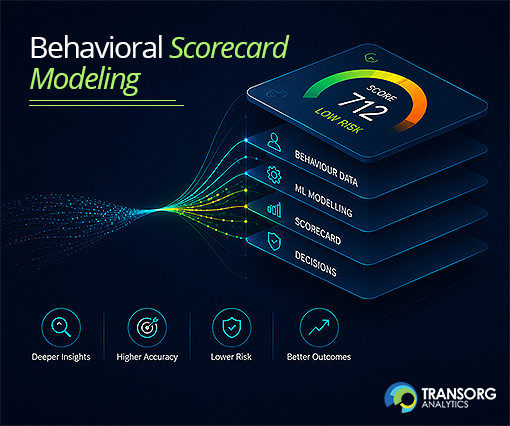
A leading Indian bank sought to strengthen collections efficiency across its lending portfolio by accurately segmenting borrowers based on default risk. The goal was to deploy a unified behavioral scorecard framework across five loan products, Loan Against Property (LAP), Business Interest Loans (BIL), Small Business Interest Loans (SBIL), Personal Loans (PIL), and Small Business Banking (SBB), covering approximately 84,000 accounts and USD 567M in outstanding balances, to route outreach efforts to where recovery potential was highest and eliminate wasted collections activity on low-risk accounts.
Solution
Data Preparation: Commercial tradelines with outstanding balances below ₹100 were excluded to keep the modeling base clean and decision-relevant.
Risk Signal Design: For retail products (LAP and PIL), customers with good secured loan repayment but poor payment history on small unsecured loans were flagged as elevated risk. For business products (BIL, SBIL, and SBB), stress on unsecured or revolving credit lines despite good performance on secured commercial loans was identified as an early working capital pressure signal.
Modeling Approach: A suite of product-specific behavioral scorecards was built using a unified logistic regression framework, with all five models calibrated to minimize missed defaulters over unnecessary outreach.
Collections Integration: Scorecard outputs were embedded directly into the collections system, high-risk accounts were flagged for immediate agent outreach, medium-risk accounts were routed to automated SMS and IVR queues, and low-risk accounts were removed from active contact entirely.
Refresh Cycle: All models are refreshed biennially with updated data and features to keep risk segmentation current.
Impacts Delivered
The final lead scoring model created a focused opportunity pool where a small subset of leads contributed disproportionately towards bookings:
Bad rates improved meaningfully across all five products, with reductions ranging from roughly 0.5 to 0.8% points, and 80–88% of bad accounts concentrated within the top two risk deciles.
Reduced cost per recovery, improved bounce rate performance, and protected customer relationships at scale by eliminating low-value outreach to low-risk accounts.