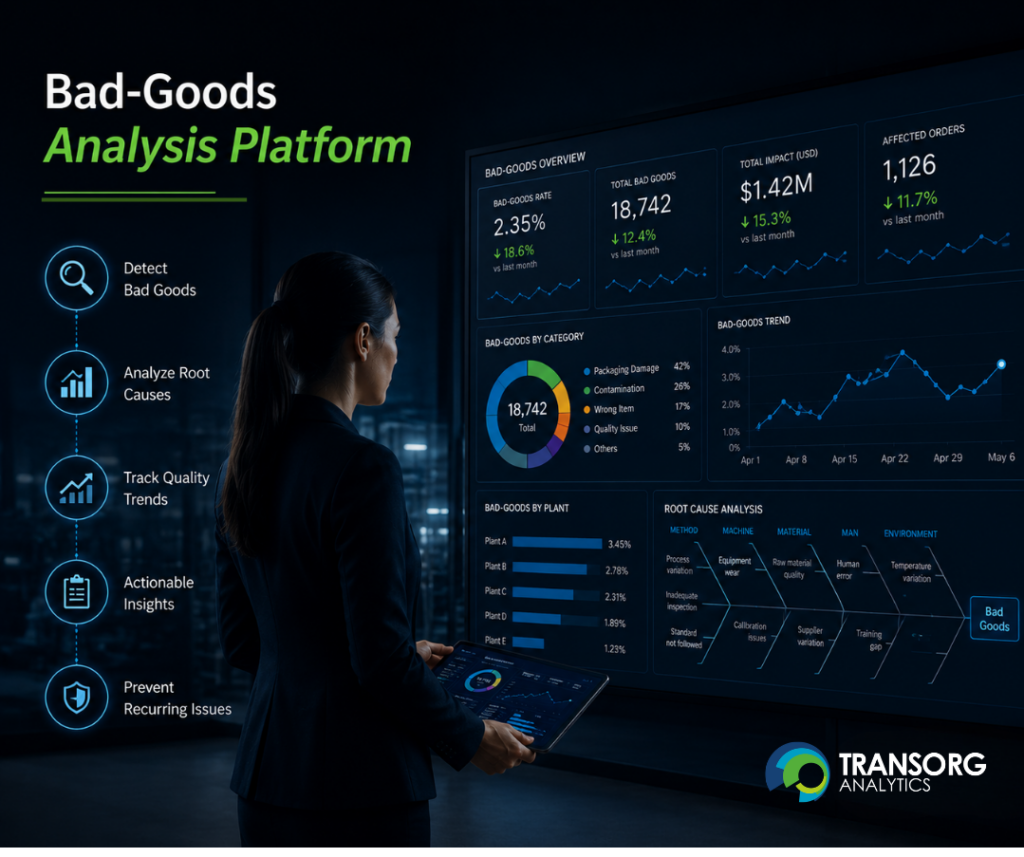
Our client, a Fortune Global 500 food and beverage leader, wanted a Bad-Goods Analysis Platform that could automate identification and escalation workflows, bring together live sales and returns data with smart thresholds and filters, deliver interactive dashboards with branch, business, and brand-level visibility, and give teams the user-friendly tools, automated alerts, and one-click exports.
Solution
Developed the lead scoring model on a dataset of ~16.6 lakh leads with a 1.17% booking rate
Conducted Exploratory Data Analysis (EDA) that established booking conversion varied significantly across source, geography, budget and lead timing behavior, and project characteristics
Engineered features and built machine learning models using Logistic Regression, Random Forest, and XGBoost, iterating the framework from a single overall model to separate Direct, Walk-in, and CP models for more granular and accurate conversion prediction
Implemented dynamic project-level Platinum tagging to maintain stable Platinum allocation across the portfolio and improve real-time usability of model outputs
Impacts Delivered
The final lead scoring model created a focused opportunity pool where a small subset of leads contributed disproportionately towards bookings:
Delivered a fully operational Bad-Goods Analysis Platform that automates the identification and management of bad goods across the entire distribution network, bringing together live sales and returns data, smart thresholds, and interactive dashboards in a single, unified system.
Established a scalable foundation for future automation and analytics initiatives.
Processed 15+ million records with zero downtime, reducing reporting and coordination effort while resolving issues faster through live escalation workflows.
Enhanced transparency and accuracy across brands and branches, giving a reliable, real-time view of bad-goods performance at every level of the distribution hierarchy.