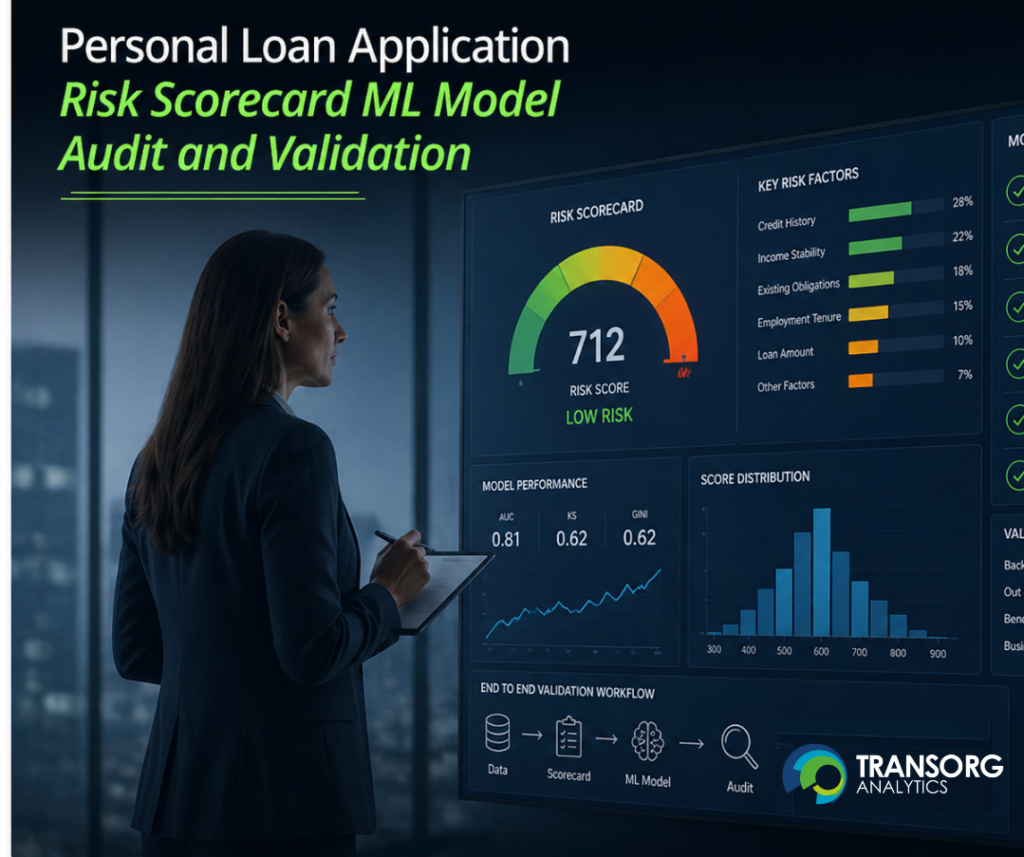
Personal Loan Application Risk Scorecard ML Model Audit and Validation
Overview
To evaluate and validate the effectiveness of the XGBoost-based credit risk ML model deployed by a leading consumer lender with a portfolio of 284,000+ active customers, ensuring:
robust predictive performance
clear and effective risk segmentation
long-term model stability
Solution
Our methodology for the ML model audit covered all validation domains, from raw data exclusions through to out-of-time stability testing:
Feature Engineering Audit: End-to-end code review, data lineage tracing, and reproducibility testing of all derived variables.
Statistical Performance Testing: Gini, AUC-ROC, and KS evaluation across train, test, and out-of-time datasets to confirm predictive power.
Population & Characteristic Stability: PSI and CSI monitoring to detect data drift and feature instability before they impact decisions.
Missing Value & Exclusion Review: Validation of imputation strategy, business exclusion logic, and population representativeness.
Decile & Rank-Order Validation: OOT decile analysis to confirm consistent risk segmentation on unseen future data.
Governance & Documentation Review: Assessment of ML model documentation, coding standards, and compliance with internal risk frameworks.
Impacts Delivered
Based on a comprehensive review of all ML model validation and audit control checkpoints, the model was deemed fit for purpose. The validation was completed successfully with zero critical, high, or medium-risk findings:
Performance metrics such as Gini, AUC-ROC, and KS demonstrate strong discriminatory power, confirming excellent risk differentiation capability.
Bivariate analyses show stable relationships between key features and bad rate with no unexpected shifts or reversals.
Stability metrics indicate minimal data drift, and CSI is well within its thresholds, confirming the model’s reliability on new data.
OOT decile analysis confirms excellent rank ordering with monotonically decreasing bad rates from the highest to the lowest risk deciles.