- Sales projections missed
- Customer churn increased unexpectedly
- Operational costs spiked beyond forecasts
But adding to this are analysts pulling data from multiple systems, finance teams running pivot tables, and operational leaders manually trying to piece together what went wrong. But by the time teams identify the root cause, weeks have passed, the market has moved on, and the opportunity to modify has been lost.
And the worst part? After all that effort, the analysis usually tells you what happened and not why it happened.
That’s the difference between correlation and cause, which is costing enterprises more than they realise. This is not a people or data problem but an architectural problem with how we approach root cause analysis in complex business environments.
The Hidden Cost of Manual Root Cause Analysis
In the age of agentic AI, most enterprises don’t realize how expensive their current approach to root cause analysis actually is.
For example: A retail chain sees an unexpected regional sales drop. Teams spend three weeks pulling data, normalizing formats, and testing hypotheses. The final answer: road construction near key stores combined with a competitor promotion. It was the right answer that was delivered two weeks after the road reopened and the competitor’s promotion ended.
The problem? The insight, while accurate, arrived too late to inform real-time decision-making.
This scenario plays out thousands of times across large organisations in supply chain optimization, customer retention analysis, financial variance investigation, and operational efficiency reviews.
The loss? The total cost of manual root cause analysis isn’t just analyst hours, but it is also missed revenue, continued inefficiencies, and decisions made on intuition rather than evidence because timely analysis simply isn’t available.
Why Adding More Analysts Doesn’t Solve the Problem
The instinctive response to slow root cause analytics is to hire more analysts or invest in better power BI and dashboarding tools. But traditional analysis requires humans to manually construct the reasoning chain, unlike agentic AI-driven root cause analysis.
Even with excellent BI platforms, someone still needs to:
- Guess which factors might have caused the problem
- Figure out which systems hold the relevant data
- Pull data from multiple places and make it work together
- Separate the real causes from the noise
- Turn the findings into actionable recommendations
Each of these steps requires domain expertise, business context, and judgment. More dashboards don’t eliminate this cognitive load; they just make the data easier to analyze manually.
Enter Agentic AI Root Cause Analysis: A New-Age Approach
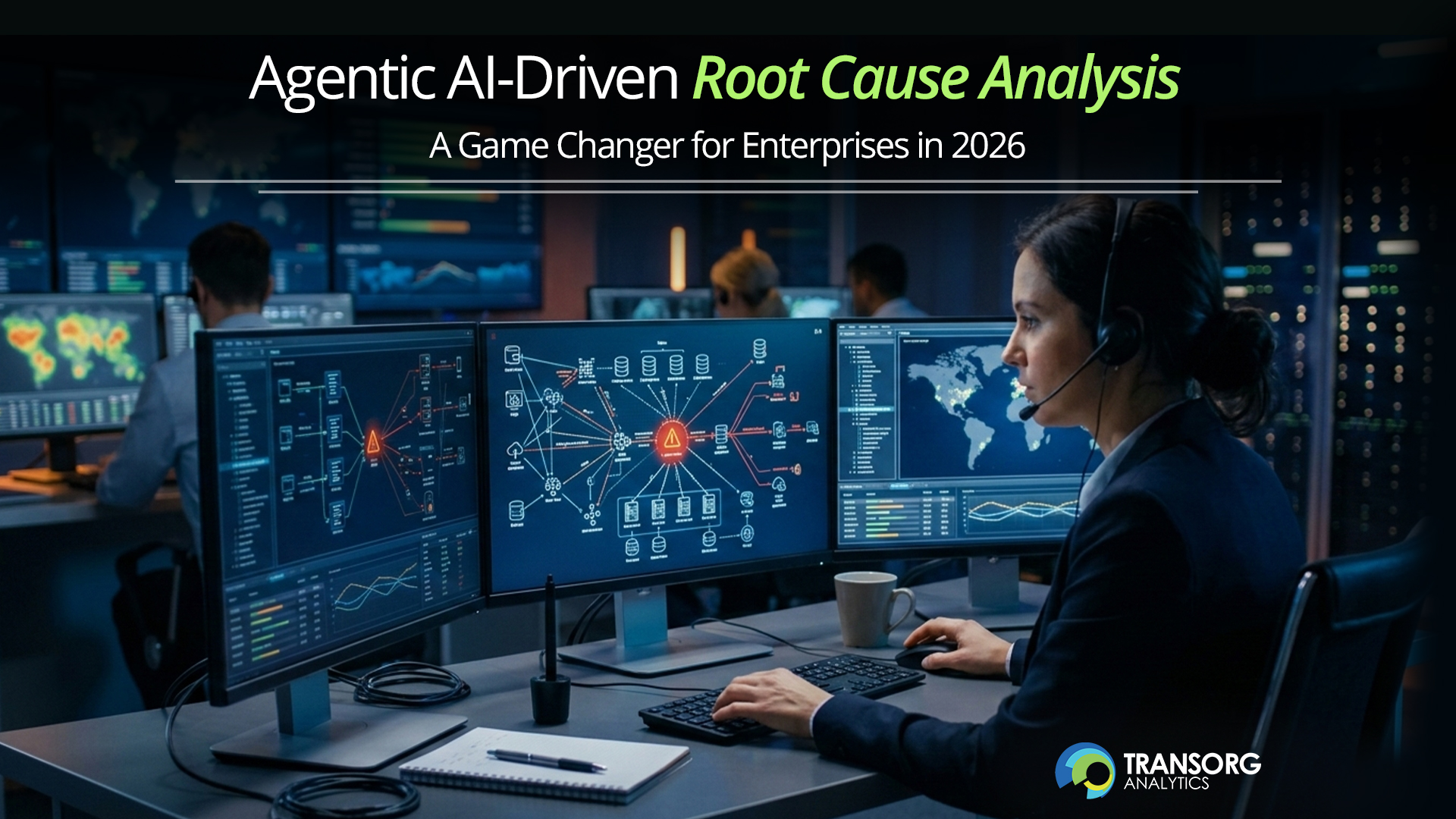
Agentic AI represents a fundamental shift in how root cause analytics happens. Rather than providing tools for humans to analyze data, agentic systems such as TransOrgIQ autonomously conduct investigations using specialized AI agents that run in parallel.
Here’s what makes the Agentic RCA approach different:
-
- Multi-AI Agents Workflow: Instead of one analyst testing a theory at a time, multiple AI agents analyze different angles simultaneously. Parallel root cause analysis means answers arrive in hours, not weeks.
- Business Glossary Integration: Traditional analytics tools are too generic. Agentic AI systems can be configured with your business glossary, operational definitions, terminology, and logic, so the analysis reflects how your organization actually works.
- Feasibility Validation Before Analysis: One of the most frustrating aspects of traditional analytics is spending hours on an analysis only to discover you lack important data. For the correct root cause analysis, agentic AI systems validate data sufficiency upfront, flagging gaps before analysis begins and explaining exactly what additional data would improve accuracy.
- Transparent Reasoning: Agentic AI systems act like explainable AI systems that don’t just present conclusions; they show the complete reasoning chain, factors considered and eliminated, and why specific drivers were identified as root causes.
Agentic RCA becomes the operating layer for trustworthy AI.
Without it:
- Your GenAI or ML initiative stays in PoC
- Every incident becomes a leadership escalation
- Scaling AI = scaling risk
With it:
- AI systems become self-diagnosing
- Production confidence improves
- Governance becomes proactive, not reactive
How Agentic AI is Transforming Root Cause Analysis
Agentic AI-powered root cause analytics come from specialized agents working together:
-
- Coordinator Agent: It understands the intent and decides what type of analysis is needed.
- Profiling Agent: It automatically understands your data structure, identifies relationships across tables, and flags quality issues before analysis begins. This eliminates the data preparation bottleneck that typically consumes 60-80% of analysis time.
- Classification Agent: For an effective root cause analysis, this determines whether you are asking descriptive (what happened?), diagnostic (why did it happen?), predictive (what will happen?), or prescriptive (what should we do?) questions to route them to specialized agents.
- Diagnostic Agent: It focuses on identifying correlations and testing causal hypotheses across your data, looking for patterns humans might miss because they span too many dimensions or involve non-linear relationships.
- Forecasting Agent: It helps you understand not just what drove past performance but also what those drivers suggest about future outcomes.
- Optimization Agent: It translates diagnostic findings into specific, actionable recommendations based on your operational constraints and business objectives.
If you are wondering what agentic AI-driven root cause analysis looks like in practice? This short video shows exactly how it works and why it changes everything.
Real Impact of Agentic AI-Powered Root Cause Analysis
Root cause analytics done by agentic AI in GCCs and large enterprises in minutes to weeks is not just about convenience, but it fundamentally changes what’s possible.
- 60–80% faster incident resolution (MTTR)
- Reduces cost of bad business decisions for enterprises
- Cuts engineering investigation effort by up to 50%
- Enables scalable and trustworthy AI deployments
The Bottom Line
Enterprise AI projects cannot move from pilot to production to scale unless you can detect, diagnose, and resolve production-level failures autonomously. The data you need likely already exists in your systems. The questions your teams need answered are already being asked. The only thing missing is an architecture that can connect the two in minutes instead of weeks. So, the question isn’t whether agentic AI will transform root cause analytics in enterprises, but whether your organization will adopt an agentic AI-driven root cause analysis approach for that competitive edge. Connect with us today if you are interested in using agentic RCA for your enterprise to unlock faster insights and reduce costs.
FAQs on Root Cause Analysis in Enterprises in 2026
1- Which industries benefit most from Agentic AI RCA?
Industries with complex digital ecosystems benefit the most, including banking, financial services, healthcare, telecommunications, retail and e-commerce, aviation, and automotive. These sectors rely heavily on reliable data pipelines and AI-driven decision-making systems.
2- Why is agentic AI RCA so powerful?
Agentic AI root cause analysis can identify real causes without constant human input. It anticipates needs, understands and classifies your data structure, and translates diagnostic findings into specific, actionable recommendations.
3- How does agentic AI improve data pipeline reliability?
Agentic AI continuously evaluates pipeline health by analyzing ingestion rates, transformation errors, and latency metrics. When anomalies are detected, it correlates them with recent changes to identify the most likely failure point.
4- What is the difference between monitoring and root cause analysis?
Monitoring systems detect when something goes wrong by triggering alerts based on predefined values. Root Cause Analysis goes a step further by identifying why the incident occurred by analyzing dependencies, recent changes, and correlated anomalies across systems.
5- Can agentic AI analyze unstructured data for RCA?
Yes. Agentic AI can analyze unstructured data such as log messages, system events, and support tickets using natural language processing to identify patterns associated with recurring failures.