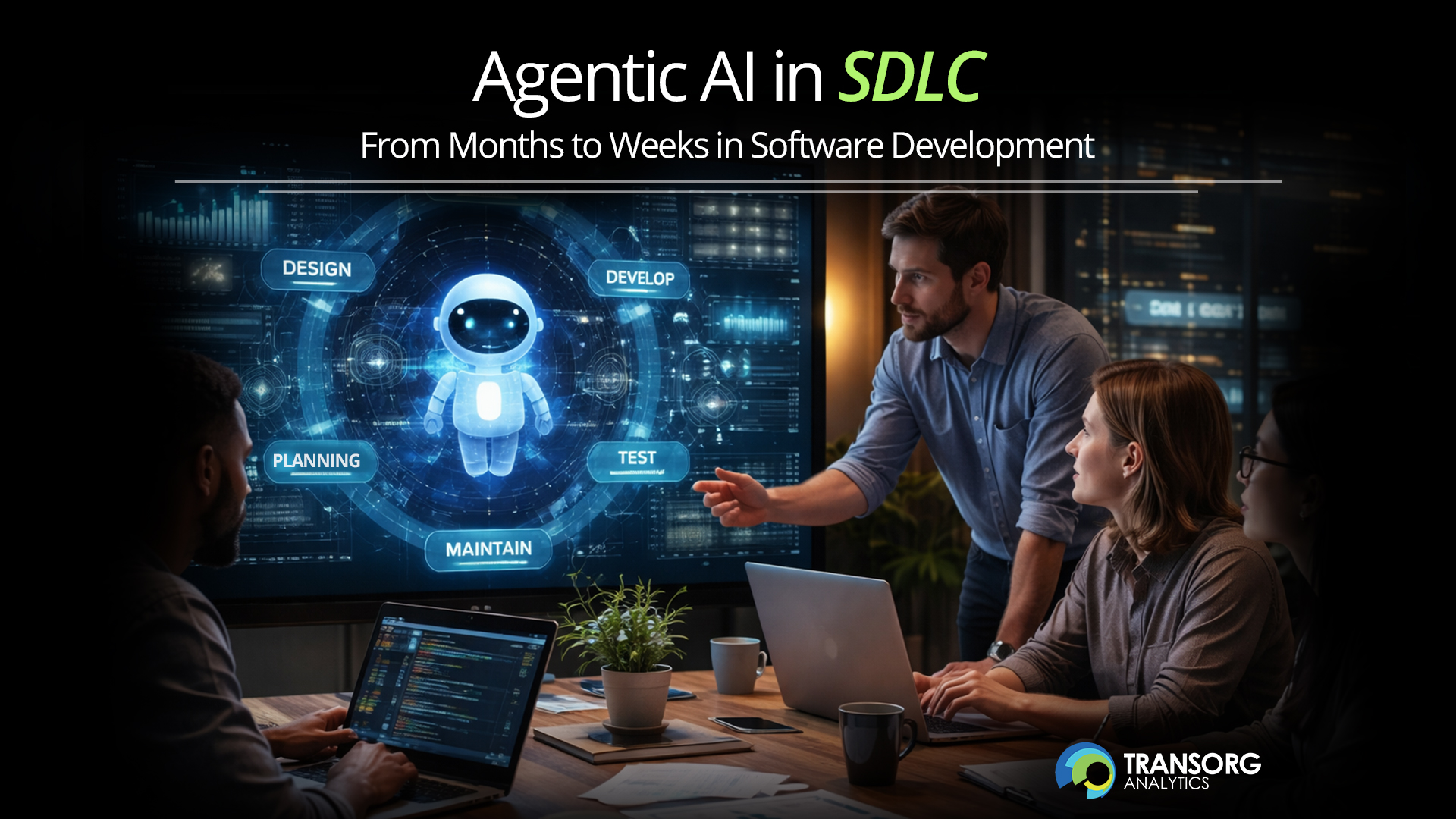
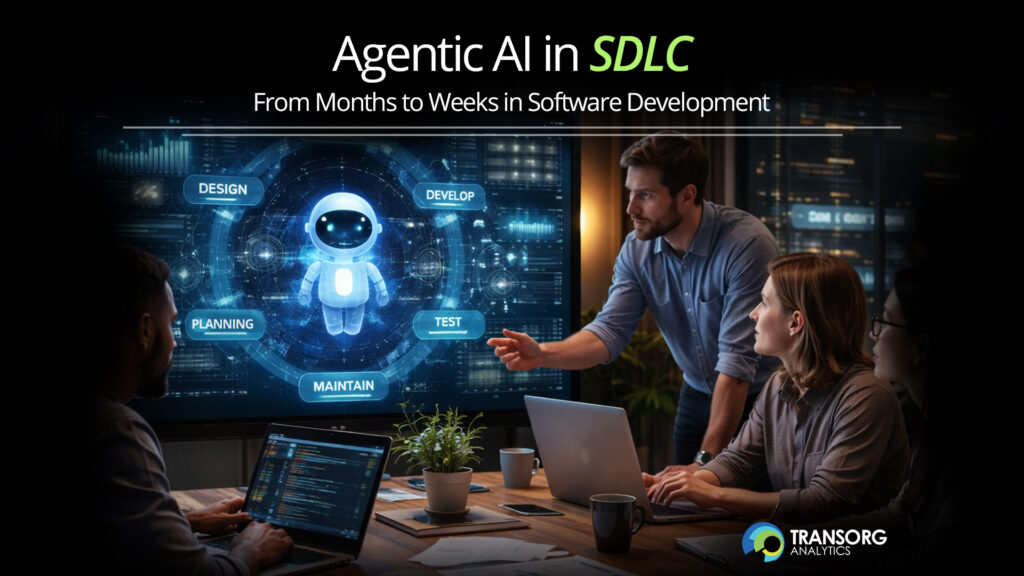
While your development teams use several different tools across the SDLC, your competitors are using an agentic AI-powered SDLC platform to turn months of work into weeks. This is not just a productivity problem, but an existential threat to your market position.
Why are Enterprises choosing AI-powered SDLC instead of Traditional Approaches?
In regulated industries such as BFSI, CPG and Healthcare, every release, security breach and compliance gap leads to lost customer trust and revenue.
The 3 main reasons for companies to choose agentic AI-powered SDLC platform over traditional approaches are:
- The DevOps bottleneck: Traditional SDLC creates dependency blockages. When developers need to configure repositories, implement CI/CD pipelines or set up monitoring, they submit tickets to centralized DevOps teams and wait 3-5 days per request. For an enterprise with hundreds of active projects, this creates a long queue that slows down every project. This is where agentic AI-powered SDLC platforms enable faster project delivery through automated environments.
- Consistency at scale is impossible manually: When every project team manually configures their own toolchain, inconsistency becomes inevitable. One team uses Jenkins, another uses GitHub Actions and third uses GitLab CI. Security scanning happens differently across projects. Enterprise agentic AI-powered SDLC platforms enforce organizational standards automatically throughout the 5 phases, ensuring each project’s specific technology stack is taken into consideration.
- Security must be the first priority: The IBM’s 2025 Cost of a Data Breach report suggests that vulnerabilities caught in production cost 15x more to fix than those identified during development. In this context, in 2026, auditors and regulators expect security and compliance to be embedded from project inception, not to be audited before deployment. Agentic AI-powered SDLC platforms scans vulnerabilities, and risky dependencies continuously.
Core Capabilities of Agentic AI-powered SDLC Platforms across the Process
The core capabilities of agentic AI platforms such as TransOrgIQ that transform SDLC with AI and drive business outcomes are:
- Planning & Requirement Analysis: Modern enterprise AI SDLC solutions driven by agentic AI analyze backlogs, business objectives and historical delivery data to identify high-risk dependencies, optimal scope and act upon based on the changing conditions. This means, teams get adaptive planning intelligence for real-time support.
- Development & Build Automation: The agentic AI-powered SDLC platform generates standardized projects, embeds organizational best practices directly into the scaffold. Your security policies, coding standards, architectural patterns, and compliance requirements become defaults, not afterthoughts.
- Deployment & Release Optimization: With support for AWS, Azure, GCP, and on-premise environments, the agentic AI-powered SDLC platform generates version-controlled infrastructure code and handles CLI-based deployment. This eliminates the drift between environments that causes production incidents.
- Continuous testing & quality management: Testing is where TransOrgIQ, the agentic AI-powered SDLC platform delivers good impact. The platforms build automated test and deployment pipelines customized to your technology stack and deployment strategy. It supports multi-environment deployments with preview capabilities for validation before production releases. The result with AI-powered SDLC ensures tests run consistently across development, staging, and production-like conditions.
- Security and Compliance: This capability is critical for regulated industries such as BFSI, CPG and healthcare. The enterprise agentic AI-powered SDLC platform continuously scans code for vulnerabilities, identifies risky dependencies, detects leaked secrets, and validates compliance with security standards.
- Built-in Monitoring and Observability: The agentic AI-powered SDLC platform automatically configures logging, metrics tracking, and error monitoring with centralized dashboards and intelligent alerts.
Measurable Business Impact of Agentic AI-powered SDLC platforms
The quantifiable impact agentic AI for GCCs and enterprises throughout the software development lifecycle are:
- 80% reduction in project setup overhead: With agentic AI-powered SDLC platform, DevOps configurations now take hours instead of 2-3 weeks. For organizations launching several projects annually, this means efforts and time saved by the engineering team.
- Self-Service capability eliminates bottlenecks: Development teams can manage complete environments without waiting for centralized DevOps support. This means the shift from repetitive configuration work to strategic platform optimization and governance.
- Reduced security breach and compliance risks: By scanning vulnerabilities and compliance violations, organizations catch issues before they reach production through an agentic AI-powered SDLC platform. According to the studies, the average cost of a data breach in 2025 exceeded $4.5 million; preventing even one breach provides ROI that risks platform investment.
- Optimized cloud infrastructure costs: Organizations typically see 15-25% reduction in cloud spending by ensuring every environment uses right-sized, cost-optimized configurations via applying AI on SDLC phases.
What B2B leaders should consider regarding implementing AI on SDLC phases?
With organizations already detecting anomalies, finding root causes or revolutionalizing logistics through Agentic AI, integration of agentic AI in software development lifecycle is no longer optional but critical. However, with this comes the fact to adopt it responsibly, measurably and strategically.
Therefore, when evaluating agentic AI-powered SDLC platforms, C-suite leaders of highly regulated industries should focus on 4 important dimensions:
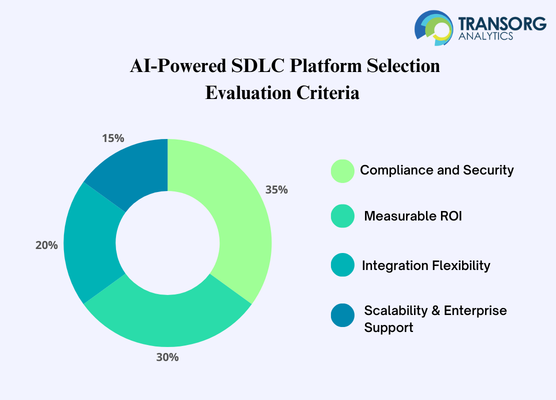
Do Agentic AI-powered SDLC platforms work with existing enterprise ecosystems?
A common concern for B2B leaders evaluating new agentic AI-powered SDLC platforms: How does this fit with our existing investments? The answer lies in understanding that new-age agentic AI SDLC platforms are designed for integration and not replacement. This means:
- These platforms connect to your existing toolchain through RESTful APIs and CLI-based workflows
- These platforms adapt to your infrastructure such as GitHub Enterprise, Azure DevOps, AWS, GCP or hybrid cloud environments rather than migration
- These platforms also respects your existing security policies and governance frameworks, enforcing the standards more consistently and automatically
Why speed matters in the Software Development Lifecycle for Industries?
In 2026, software delivery speed directly impacts competitive positioning. Companies that can transform SDLC with AI through agentic AI platforms can:
- ship features faster
- respond to market changes quicker
- launch new products faster
- gain larger market share
Agentic AI-powered SDLC platforms make release cycles more measurable and reliable. This enables:
- better business planning
- more aggressive innovation roadmaps
- aggressive market timing
Conclusion
The software development lifecycle for enterprises has become unnecessarily complex. The integration of tools, frameworks and processes has created overhead that consumes engineering capacity without delivering proportional value. Agentic AI-powered SDLC platforms eliminate the repetitive, error-prone work, saving time and efforts.
The agentic AI-powered SDLC companies gain early mover advantage for streamlined operations, reduced costs, and faster innovation cycles. For B2B leaders, the value lies in when and how to adopt these platforms.
Lastly, technology exists today. The business use case is clear. The only remaining question is: Is your organization ready to transform software development into a competitive advantage characterised by speed, security and operational efficiency. This is where TransOrgIQ gives you that edge. It brings agentic AI to the software development process by integrating planning, development, testing, deployment and release cycles into one intelligent platform.
To learn more about how TransOrgIQ can elevate your SDLC capabilities, connect with us for a customized demo today!
FAQs about Agentic AI SDLC platforms
1. How does Agentic AI SDLC platforms reduce enterprise costs?
Agentic SDLC increases the possibility of improvement around business outcomes since AI agents save time through automating repetitive tasks, early defect detection to resolve inconsistencies, and supporting new requirements in a more flexible way that’s future-proof and trusted.
2- What is the software development trend in 2026?
Platform engineering is one of the emerging trends in Agentic AI driven software development in 2026. This approach centralizes CI/CD pipelines, infrastructure, policies and security, improving consistency in project delivery and overall productivity.
3- What are the essential stages of SDLC?
The 7 essential stages of agentic AI SDLC includes planning, requirements & AI analysis, architecture and system layouts, code generation, automated testing & quality assurance, DevSecOps deployment, and data migration & maintenance.
4- Why do businesses need agentic AI SDLC platforms in 2026?
The top benefits of agentic SDLC for business include innovation and digital acceleration, enhanced project delivery and customer experience, cost efficiency and scalability in global markets.
5- What are types of software development lifecycle models?
There are 4 types of Software Development Life Cycle models guiding software creation. These are Waterfall (sequential), Agile (iterative/flexible), V-Model (testing-parallel), Spiral (risk-focused), and Incremental (building in parts).