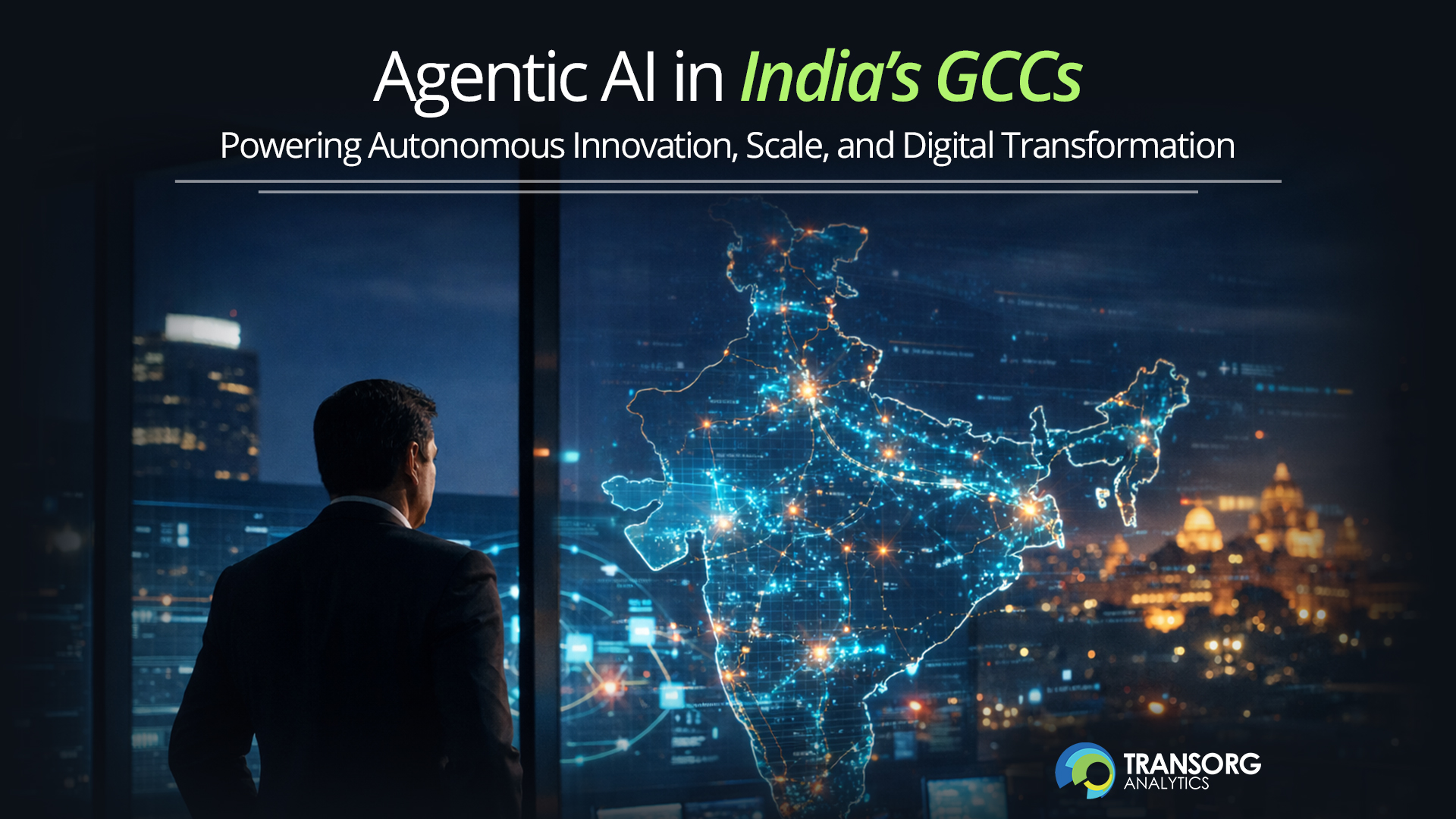

The Global Capability Centers (GCC) landscape is undergoing a massive transformation. A 2025 survey of GCCs revealed that about 58% of India’s GCCs are currently investing in Agentic AI, with another 29% planning to scale within the following year. With the disruption caused by AI automation, the wave represents a fundamental shift in how GCCs operate, derive enterprise-wide innovation, and deliver value.
Earlier, GCCs operated primarily as cost-optimization hubs, executing back-office processes with geographical arbitrage as their primary value proposition. Today, these innovation hubs influence how their parent companies run their operations worldwide. Recent industry research indicates that 92% of GCC leaders say their centers have evolved beyond simply cutting costs.
You may wonder, what lies behind India’s GCC boom in this digital age? The answer is Agentic AI. The autonomous systems are outcome-focused and convert insights into actionable processes, KPIs, and real-time automations, in contrast to traditional enterprise AI solutions.
What is Agentic AI in GCC Operations?
One of the most important questions that we see is what makes Agentic AI fundamentally different from the AI tools most organizations currently deploy?
Conventional AI systems are reactive. Queries are answered, data is processed in accordance with predetermined criteria, and each choice necessitates human intervention. Even advanced generative AI tools, such as ChatGPT or industry-leading productivity AI assistants, serve mainly as productivity boosters, enhancing human abilities rather than functioning independently.
Agentic AI, in contrast, has 3 important capabilities that enable industry edge-
- Goal-Oriented Planning: Similar to how a senior leader would handle a complex issue, autonomous agentic agents are able to break down complicated goals into manageable steps, develop action plans, execute them, and measure impact.
- Environmental Awareness: By collecting real-time data from many sources, comprehending context, and identifying when conditions change, these systems continuously monitor their operational environment.
- Continuous Learning: These systems improve performance over time without intentional reprogramming by refining their decision-making models through feedback loops and outcome analysis.
What Business Impact does Agentic AI Create for GCC Operations?
The major driving factor behind GCC’s transformation from cost centers to innovation hubs is Agentic AI and advanced analytics. The recent industry survey reveals that 67% of GCCs are now creating dedicated innovation teams and incubation programs to create new value rather than merely optimizing existing processes.
This shift is reflected in operational metrics as well, where 86% of GCCs have adopted business intelligence capabilities, compared to 80% last year, while 67% now have formal data strategies in place, compared to only 51% previously.
GCCs are shaping global strategies, driving digital transformation initiatives, and adopting emerging technologies across the enterprise. With applications across business areas such as customer service, finance, operations, IT and cybersecurity, this evolution perfectly represents the critical inflection point where Agentic AI moves from potential to performance.
How Agentic AI is Transforming Enterprise Workflows
Process automation through Agentic AI works on monitoring tools that don’t just alert human operators but diagnose the issue, identify root causes, determine optimal strategies, execute fixes, verify resolution, and provide proper documentation for future reference.
1.IT Operations
According to the latest industry research, IT operations represent perhaps the most mature application of Agentic AI in GCCs. By 2028, 33% of enterprise software applications will include Agentic AI, up from less than 1% in 2024.
2. Customer Service
Customer service represents the most visible and impactful application of Agentic AI. The key distinction from current chatbots is autonomy across systems. When a customer requests an order change, an Agentic system doesn’t just provide information; it accesses inventory systems, evaluates fulfilment options, modifies warehouse picking instructions, updates shipping arrangements, processes any pricing adjustments, sends confirmations, and proactively monitors delivery to ensure the change is executed correctly.
3. Supply Chain and Operations
Supply chain operations in GCCs are leveraging Agentic AI for multi-variable optimization that was previously impossible. These systems continuously ingest data from production facilities, weather services, economic indicators, and market intelligence, then autonomously adjust inventory positioning, optimize logistics routing, predict maintenance requirements, and coordinate across the supply network, adapting in real-time as conditions change.
ROI insights for GCCs through Agentic AI in the Coming Years
While the latest industry insights support the thought of why GCCs in India are investing in Agentic AI, as an industry leader, you may also want to know what ROI can enterprises expect from Agentic AI adoption in GCCs.
Well, according to industry estimates, by 2030, Agentic AI could increase yearly income by $450–650 billion, or 5-10%, in advanced industries. Organizations are claiming 30-50% cost reductions via improved processes and automation at the same time.
In this regard, the important question for GCC leaders isn’t whether to adopt Agentic AI for digital transformation, but how quickly they can scale it before competitors establish numerous benefits.
However, McKinsey’s research on autonomous labor capacity may be the most remarkable example of AI automation’s growing potential: Since 2019, the duration of tasks has doubled every seven months, and since 2024, it has doubled every four months. At the moment, AI systems can consistently finish two hours of work on their own. By 2027, they could finish four days of work without supervision, which is comparable to a mid-tenure employee working on their own.
On a larger scale, GCCs will achieve these benefits by deploying Agentic AI:
- Real-time adaptation to market changes without waiting for manual decision-making cycles
- Faster experimentation and deployment of new data engineering services, with AI systems identifying opportunities and executing pilots autonomously
- Reduction in operational costs and improvement in service quality
- Reduction of human talent from routine decisions, enabling focus on genuinely strategic initiatives requiring creativity, judgement, and relationship-building
How do Enterprises Choose Which Processes to Modernize using Agentic AI?
The adoption of Agentic AI by enterprises is not done randomly. A well-structured, ROI-driven, and risk-aware approach is the foundation for the successful implementation of an AI strategy. The goal is to identify workflows where autonomous AI agents take the lead in coming years to deliver measurable, actionable, and accurate insights without disrupting the existing operating systems.
Look for processes such as reporting cycles, compliance documentation, customer sentiment analysis, data preparation, etc., because these are-
- Highly repetitive or rule-based
- Dependent on manual effort
- Prone to delays or backlogs
- Spread across multiple teams or tools
- Costly to scale with manpower
Further, before investing, map processes based on business impact and technical feasibility, such as-
- Cost reduction
- Faster turnaround
- Reduced errors
- Better customer experience
- Higher revenue or conversions
- System integration requirements
- Data quality
- Compliance constraints
Start AI automation with low and medium-risk processes to build confidence, frameworks, and data governance. Then move to high-risk areas and wait until guardrails, audits, and oversight mechanisms are in place.
Risks Associated with Implementing Agentic AI & How to Navigate Them
Despite the endless growth opportunities of enterprise Agentic AI solutions across industries, implementing AI automation at scale comes with its own set of challenges and risks. The latest predictions say that 40% of the AI projects will be cancelled by the end of 2027 due to rising costs, unclear business value, and inadequate risk controls.
The question here is, why are so many initiatives expected to fail? The primary reasons are consistent across industries:
- Unclear Business Objectives – Enterprizes launch Agentic AI automation processes without clear success metrics and defined use cases, leading to vague efforts that deliver marginal value rather than transformational value.
- Data Infrastructure Gaps – To implement Agentic AI solutions, systems have to be integrated with real-time data access. However, many GCCs discover their data governance, quality, and integration capabilities are insufficient only after project launch.
- Inadequate Data Governance Frameworks – Autonomous decision-making requires strong guardrails: defining decision boundaries, establishing override protocols, ensuring audit trails and managing liability when AI decisions give adverse outcomes.
- Change Management Underinvestment – The shift from human-in-the-loop to human-on-the-loop represents a big shift in operating models, job roles, and organizational culture. 71% of GCCs are prioritizing upskilling initiatives, with 81% training teams on generative AI, but training alone isn’t sufficient without addressing workforce adaptability and flexibility.
In this regard, Forrester emphasizes that organizations should collaborate with AI service providers for implementing AI strategy and data engineering solutions rather than building independently to benefit from proven frameworks, pre-built agent libraries, and implementation methodologies that derisk deployment.
TransOrg Analytics’ rich experience in implementing Agentic AI solutions for GCCs consistently validates a phased approach synced with AI governance initiatives to derisk deployment.
Final Thoughts
The transformation of Global Capability Centers through Agentic AI shows one of the most significant shifts in enterprise-wide innovation. From just cost centers focused on labor arbitrage, GCCs are now becoming the new innovation hubs driving strategic value.
For organizations ready to lead rather than follow, the opportunity is extraordinary. But success requires moving beyond pilots and proof-of-concepts to enterprise-scale deployment with robust governance and product engineering expertise, integrated data foundations, and organisational readiness.
The question facing every GCC leader today: will you pave the way for the autonomous GCC of tomorrow, or will you spend the next five years playing catch-up with competitors who acted today?
FAQs
1- How are GCCs in India using Agentic AI in 2026?
In the coming year, India’s Global Capability Centers will have moved from experimentation to production pilots of Agentic AI. The use cases where you will actually see Agentic AI solutions being implemented include CLTV, flag anomalies, data mapping and modelling, feature extraction, document parsing & text validation and verification, etc.
2- What is the future of GCCs in India with Agentic AI in place?
With Agentic AI in place, GCCs are becoming innovation hubs, driving product, process, and decision automation for their global enterprises. GCCs are expected to evolve into the organization’s R&D and execution backbone for AI-native products and business models, influencing corporate strategy rather than only delivering services.
3- What are the key risks and data governance guardrails GCC leaders must prioritize in the Agentic AI era?
The key risks and data governance guardrails that GCC leaders must take into account include auditability, validation pipelines, reskilling programs, role transitions, safe roll backs and human-in-the-loop for unusual situations.
4- Which GCC functions will benefit the most from Agentic AI by 2026?
Through predictive analytics, autonomous support, proactive engagement with customer issues, and personalization, in GCCs by 2026, the Finance and Customer Experience (CX) functions are expected to benefit the most from Agentic AI solutions. Since these functions offer faster and measurable returns through enhanced efficiency and autonomy.