Introduction
Data is the most valuable asset for enterprises. Most enterprises have made the investment in modern data stacks, cloud infrastructure, and analytics platforms; yet
- Marketing campaigns miss the mark
- Outreach targets businesses that no longer exist
- Customer records are outdated, incomplete, or simply wrong
What looks like an ‘AI failure’ across global industries is actually an upstream breakdown in how data is captured, validated, enriched, and governed, because even the most high-performing model is only as good as the data feeding it.
Traditional data governance approaches were not built for the volume and complexity that modern enterprises now operate at. Agentic AI for data management changes that question and brings automation, intelligence, and scale in ways that manual processes never could.
Keep reading to learn more about what that transformation looks like with agentic data management for your data, your teams and your business outcomes.
What is Agentic AI in Data Management?
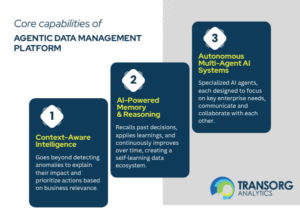
Agentic AI for data management refers to autonomous multi-AI agent systems that proactively manage and monitor workflows and optimize data pipeline management, governance, and quality with minimal human intervention.
Traditional AI Tools vs Agentic AI Systems
Traditional AI tools are reactive. They react to instructions that you give, but agentic AI systems act independently by detecting anomalies, fixing data quality issues, and enforcing data lineage automation continuously, without human intervention at every step.
Why does this matter? A traditional AI tool can tell you that a pipeline broke. Agentic AI for data management:
- identifies the break
- traces its origin
- flags downstream impact
- initiates fixes before the business feels it
3 Layers Where Data Quality Breaks Down
The data quality problem with agentic AI for data management is not a single point of failure. With the addition of the unstructured data, it breaks across three interconnected layers:
1- Data Capture Issues
- Every skipped field is a silent bet against future revenue. When a salesperson fails to capture mandatory data in a hurry, the sale may happen, but the record that enters the system is incomplete.
- This structurally incomplete data flows into the system, causing triggers. These data quality issues cost far more than the 30 seconds it saved.
2- Data Pipeline Issues
- Organizations often have data sitting in siloed applications. These systems give incorrect metrics, misaligned insights, and disconnected results. Effective data pipeline management requires continuous monitoring, not periodic audits.
- Data engineering teams spend enormous time manually connecting sources, chasing lineage issues, and trying to deliver clean data to analytical consumers. It is a constant, resource-intensive struggle for your teams, which agentic AI for data management is purpose-built to eliminate.
3- Data Architecture Failures
- Poorly designed data models create redundancy because of integration errors, mismatched schemas, and the absence of a unified governance layer.
- With no ownership or accountability structure for data assets, the data that appears complete may also be structurally incomplete without any visible warnings.
Most enterprise data quality issues originate from fragmented data tools, broken data pipelines, and the absence of centralized data governance frameworks.
Why Enterprises are choosing Agentic AI for Data Management
Agentic data management platforms such as TransOrgIQ are different from simple LLMs like ChatGPT or Gemini. While these tools work well for a few data tables and small-scale queries, agentic AI in data analytics deals with thousands of interconnected tables and complex data lineage through AI agents or autonomous AI systems.
Data management processes through TransOrgIQ, our agentic AI platform, ensures seamless, monitored and optimized data flow across all systems, reducing both manual intervention and data quality issues.
Agentic Data Management Process
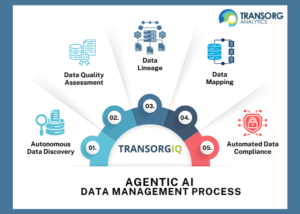
- Autonomous Data Discovery- Specialized AI agents for specific business actions scan, analyze, and catalog every database, table, and column across fragmented systems. This step through agentic AI for data management auto detects schemas, relationships, and Personally Identifiable Information (PII).
- Data Quality Checks- Agents evaluate quality dimensions, flag fill-rate issues, and detect partial data flows from source to destination to give findings into prioritized recommendations.
- Data Lineage Automation- Automated lineage graphs that trace table-level, column-level, and individual value flows, including aggregation and decomposition from source to destination for complete data observability.
- Data Mapping- Agentic AI data mapping and modeling include vector search + LLM reasoning maps sourcing columns to CDM standards to flag high-confidence matches and borderline cases for human review.
- Data Compliance: Based on your business policies, the agents validate and enforce data policies. Their job does not end here. In case of uncertainty, the agents flag for human review. Thus, agentic AI for data management ensures data governance, compliance and audit-ready insights.
Benefits of Agentic Data Management for Enterprises
The core advantages of enterprise agentic AI data management for competitive advantage include:
- Data Lineage Automation- In complex enterprise environments, for example, global compatibility centers, manually understanding where data comes from and transforms across systems is a painful challenge. With agentic AI for data management in picture, AI continuously maps how data flows and transforms across all systems, and when something is broken, the path back to the source is already known.
- Real-time Data Observability: For businesses, proactive issue detection through data observability with AI ensures real-time health monitoring across every layer. Your teams are able to catch anomalies and detect schema drifts and data pipeline failures as they happen, not days or weeks later.
- Continuous Data Quality Monitoring- With agentic AI for data management, data quality checks are not periodic, manual, and incomplete. Agentic AI runs automated checks at the pipeline, schema, and record levels continuously, not on demand. Thus, quality assessment is constant, automated, and faster.
- Real-time Policy Extraction and Validation- Agentic data management applies and enforces business policies in real-time at the point of ingestion, transformation, and delivery. They operate continuously and consistently to ensure that every data asset across the enterprise meets the business standards and regulatory compliance.
How Agentic AI for Data Management Transforms Business Team Roles
Traditional data and analytics roles were built around limitations such as slow pipelines and manual governance. Enterprise teams relied on IT. This has changed since the agentic AI in analytics and data management has entered the market.
- Instead of manually fixing broken pipelines and chasing data quality issues, AI in data engineering has enabled automated pipeline monitoring, schema validation, and anomaly detection, allowing engineers to focus on architecture and scalability.
- Earlier data analysts spent 60-80% of their time on cleaning and preparing data. Agentic AI in data analytics has helped them to spend time on insights rather than on data cleaning.
- In past years, business owners made decisions based on incomplete, biased or outdated data. But now, Agentic AI for data management for CEOs and business owners gives access to reliable, real-time data for better targeting, forecasting and decision-making.
Customer 360 Data Strategy and Beyond
Customer 360 is a unified and accurate view of every customer built from governed and connected data sources. Implementation of agentic AI for data management lays the foundation for a strong customer 360 data strategy by:
- Giving a single, trusted view of every customer from various sources such as CRM, transactions, support interactions, etc.
- Cleaner data for more personalized targeting and enhanced marketing analytics.
- Faster time to insight and decision-making since the data is available in real-time.
- Stronger compliance on customer data platforms since customer data carries significant risk, such as PII exposure and consent management.
Endnote
Agentic data management automates repetitive tasks and ensures real-time support 24/7. Autonomous AI agents process and interpret large data sets simultaneously to generate data-driven and actionable insights for personalized outreach.
If you want to position yourself for success in the current market, implementing agentic AI for data management gives you that edge.
Connect with us today to learn how TransOrg Analytics can help you enhance customer interactions and boost efficiency through agentic AI.
Key Takeaways
Agentic data management transforms the way enterprises think, learn and act. The key takeaways are:
- Agentic AI for data management automates complex workflows by eliminating manual efforts.
- Agentic AI solves data quality issues arising from wrong data capture, data pipeline management and broken data architecture.
- AI in data engineering and analytics is shifting business teams’ focus from maintenance to value creation.
- Strong data management lays the foundation for reliable, compliant and audit-ready enterprise systems.
FAQs
1- What is agentic AI for data management?
Agentic data management uses autonomous multi-AI agents to manage data pipelines, architecture, quality and governance with minimal human intervention. Agentic systems monitor, detect, think, learn and resolve data issues in real-time continuously.
2- What is data lineage automation?
Data lineage automation refers to the use of AI systems to continuously track and determine the source of origin of data assets through the organization. It also helps to determine how the data moves, transforms, where it’s stored and who accesses it across the organization.
3- How is AI used in data engineering?
AI in data engineering automates pipeline monitoring schema validation, anomaly detection, and data transformation workflows. This enables faster, more reliable data delivery across the organization and reduces the manual burden on data engineers.
4- What causes data quality issues in enterprises?
Data quality issues are caused by data capture failures, broken pipelines, and weak data governance frameworks. This is improved by agentic AI for data management because it enables real-time checks at each layer, leading to reduced errors and failure across downstream systems.
5- How does AI improve data governance?
AI improves data governance by automating data lineage tracking, data observability, data mapping and modeling, enforcing policies in real-time. This replaces periodic manual audits that are reliable and compliant.
6- What is data observability with AI?
Data observability with AI is the ability to monitor data health across every layer of the data stack in real-time. It enables teams to detect and fix issues such as anomalies, schema drift and pipeline failures faster and more accurately before they impact business operations.